The Global Clean Hydrogen Programme (GCHP)
The Global Clean Hydrogen Programme (GCHP), funded by the GEF, aims to enhance national institutional capacities, enable policy frameworks, improve technological readiness and financial mechanisms for the successful uptake of clean hydrogen in developing countries and economies in transition, ensuring their net-zero development with social considerations and benefits.
This will contribute to the reduction of global greenhouse gas emissions by promoting green hydrogen technology in developing countries and economies in transition. The Programme consists of nine child projects at country level alongside one global child project, coordinated by UNIDO.
The countries in the programme are
At the global level, the GCHP strengthens institutional capacities and knowledge-sharing platforms; at the country level, it addresses policy, technical readiness, stakeholder engagement, and financing barriers. The Programme targets hard-to-abate sectors such as chemicals, iron and steel, and heavy transport, aligns with NDCs, and leverages significant public and private co-financing.
The GCHP is designed to achieve significant environmental, economic, and social impacts aligned with countries’ NDCs and broader sustainable development priorities.
Key outcomes include:
- Policy & Technical Readiness: Development of national standards and strengthened local capacities for green hydrogen production and use, focused on industrial and transport sectors.
- Pilot Projects and Industrial Clusters: Identification and support of specific industrial clusters (such as the Vaal SEZ in South Africa and similar initiatives in other partner countries) to demonstrate tangible carbon emission reductions through green hydrogen solutions.
- Financial Mechanisms: Capacity-building for financial institutions and private sector developers to improve financial readiness and investability of clean hydrogen projects.
- Capacity Building and Skills Development: Training and empowerment of local stakeholders, ensuring inclusive participation particularly for women and youth, enhancing long-term employment opportunities and social benefits.
- Environmental and Socioeconomic Impact: An estimated 10 million tons of CO₂e mitigated cumulatively, with inclusive capacity building for women and youth and new employment opportunities.
At the global level, GCHP establishes a centralized Global Knowledge Platform, coordinated by the Global Child Project, which disseminates technical resources, best practices, case studies, and lessons learned across participating countries. Country-specific child projects contribute national knowledge products, participate in international working groups, and organize dissemination events for policymakers, private sector stakeholders, and civil society, supporting South-South cooperation and knowledge exchange.
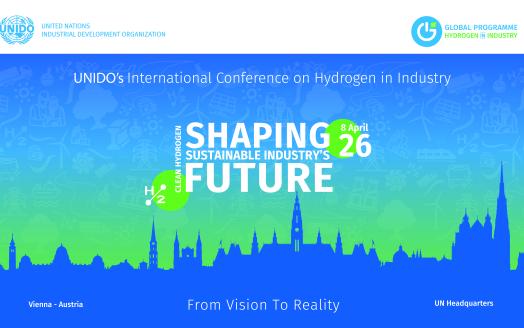
The international working groups for the GCHP were launched in April 2026, prior to UNIDO’s hosting of the first International Conference on Hydrogen in Industry, “Clean Hydrogen: Shaping Sustainable Industry’s Future,” in Vienna and online, bringing together policymakers, industry leaders, and international partners to advance financing, technical readiness, and market development for clean hydrogen in developing and transition economies.
Highlights
Advanced Filter